
Finding the right autism anxiety management techniques can feel overwhelming, especially when so much advice out there is not designed with autistic people in mind. A striking 84% of autistic adults have been told to stop or suppress stimming, despite describing it as “calming,” “safe,” and “soothing” — a clear sign that many of the most effective self-regulation tools are often the ones least understood by the people around us.
At Aspire Ireland, we have been walking alongside the autistic community since 1995. We know that anxiety is not a character flaw or an inevitable part of being autistic. It is very often a response to environments, systems, and expectations that were never built with autistic people in mind. The good news is that there are genuinely helpful, strengths-based techniques that work with how autistic brains are wired, not against them.
—
Key Takeaways
| Question | Quick Answer |
|---|---|
| What causes anxiety in autistic people? | It is most often a response to sensory overload, unpredictability, or environments that are not inclusive, rather than something inherent to autism itself. |
| Is stimming a good anxiety management technique for autistic people? | Yes. Stimming is a natural self-regulation tool. Supporting it, rather than suppressing it, is a core part of effective anxiety management. |
| Do autism anxiety management techniques differ for auDHD people? | Yes. People who are auDHD (autistic and ADHD) often experience anxiety that is layered and fast-moving, and may benefit from slightly different approaches that account for both profiles. |
| Does routine help with autism anxiety? | Absolutely. Predictability and clear structure give the brain room to relax rather than stay on alert. |
| Where can autistic people in Ireland find anxiety support? | Aspire Ireland offers guidance on seeking support, peer community groups, and practical advice through our advice and guidance resources. |
| Can special interests reduce anxiety in autistic people? | Yes. Engaging deeply with a special interest creates a sense of calm, mastery, and control that is one of the most powerful natural regulation tools available. |
| Are autism anxiety management techniques the same for children and adults? | Core principles overlap, but the specific tools and how they are applied will differ. Adults have more autonomy to shape their environments, which is a major advantage. |
—
Understanding Anxiety in the Autistic Experience
Before we explore specific techniques, it helps to understand what anxiety actually looks like for many autistic people. It is not always the racing heart or visible panic that people associate with the word “anxiety.”
For many autistic individuals, anxiety can show up as shutdown, sensory sensitivity spikes, difficulty initiating tasks, or a deep need to avoid certain places or situations. It can be quiet and invisible, which means it often goes unrecognised for a long time.
Crucially, anxiety is very often a response to the environment rather than something generated from within. Research consistently shows that non-inclusive environments, unpredictable social situations, and sensory-hostile spaces are the primary triggers. In fact, 47% of autistic people report experiencing severe levels of anxiety on a regular basis as a direct result of navigating environments that were not designed for them.
This is the framing we always start from at Aspire Ireland. Understanding what autism actually involves is the foundation for finding strategies that genuinely fit.
—
Best Autism Anxiety Management Techniques for Sensory Overload
Sensory overload is one of the most common drivers of anxiety for autistic people. When the brain is receiving too much input at once, be it noise, light, texture, or smell, the nervous system goes into a state of high alert.
Here are some of the most effective autism anxiety management techniques for sensory overload:
- Noise-cancelling headphones or earplugs: One of the simplest and most impactful tools. Reducing auditory input can lower overall arousal levels quickly.
- Weighted blankets or pressure items: Deep pressure input can be deeply regulating for many autistic people, creating a sense of containment and calm.
- Dimming or adjusting lighting: Fluorescent lights are a common sensory trigger. Warm, diffused lighting or natural light tends to be much more comfortable.
- Creating a designated low-stimulation space: Having a corner, room, or even a chair that is known as a “safe and quiet spot” gives the nervous system somewhere to land.
- Grounding through touch: Running hands under cool water, holding a smooth stone, or pressing feet firmly into the floor can help bring awareness back to the body in a gentle way.
- Scent regulation: Some autistic people find particular scents (lavender, familiar smells from home) grounding, while others are highly sensitive to them. Learning your own sensory profile is key.
These approaches work with the autistic nervous system rather than asking it to simply “cope.” That is what makes them genuinely useful rather than just theoretically nice ideas.
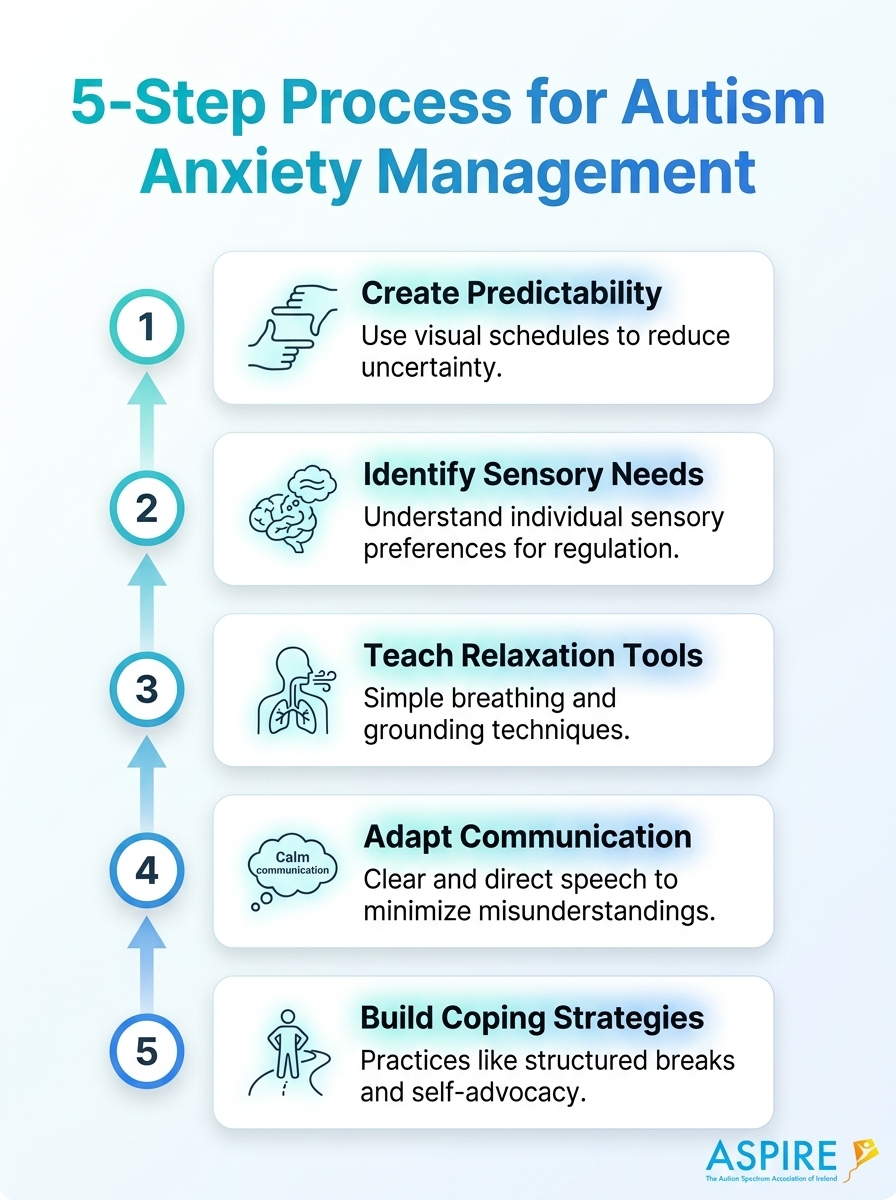
A clear 5-step approach to autism anxiety management. Practical techniques you can apply daily.
—
How Routine and Predictability Support Autism Anxiety Management
One of the most consistently reliable autism anxiety management techniques is building predictability into daily life. For many autistic people, uncertainty is not just uncomfortable — it is one of the most significant sources of ongoing stress.
When the brain is not spending energy bracing for what might happen next, it can relax. That is not a luxury; it is a genuine regulation strategy.
Practical ways to build routine and predictability:
- Use visual timetables or written schedules to map out the day, especially on days with new activities or transitions.
- Build consistent anchor points into each day, such as the same morning routine, the same lunchtime, or the same wind-down activity each evening.
- Where change is coming (appointments, travel, new environments), plan ahead with as much detail as possible. Some people find it helpful to visit new places in advance, or to look at photos online first.
- Create “if/then” plans for unpredictable situations (for example, “if the place is too loud, I will wait outside”).
- Be intentional about transitions — moving from one activity or environment to another is often when anxiety spikes.
Routine is not rigidity. It is a tool that frees up mental energy for things that actually matter.
Did You Know?
80% of autistic children and young people use stimming (repetitive movements) as a natural and effective mechanism to reduce anxiety and restore internal balance.
Source: catalystgrp.co.uk —
Stimming: A Natural and Effective Autism Anxiety Management Technique
Stimming (self-stimulatory behaviour) is one of the most powerful and natural autism anxiety management techniques available. Rocking, hand-flapping, humming, fidgeting, pacing — these are not problem behaviours. They are the body’s own way of processing and regulating overwhelming input.
Rather than asking autistic people to suppress stimming, the most helpful thing we can do is to make space for it.
“Stimming is not a symptom to be managed. It is a skill to be supported.”
How to support stimming as a regulation tool:
- Create environments where stimming is accepted and welcomed, not just tolerated.
- Provide fidget tools, sensory items, or movement opportunities — particularly in work, school, or social settings.
- If a person’s stim is causing them physical discomfort, work collaboratively to find an alternative that provides the same type of sensory input.
- Resist the urge to redirect or suppress stimming unless safety is a genuine concern.
For those of us at Aspire Ireland who work alongside autistic people every day, supporting stimming openly is part of what it means to be a truly inclusive environment.
—
Special Interests as Autism Anxiety Management Techniques
Special interests are often framed as an “autistic quirk,” but they are actually a remarkably effective anxiety management resource. Research shows that more than two-thirds of autistic individuals find that deeply focusing on a specific topic helps them stay calm, regulated, and content.
When an autistic person engages with their special interest, something important happens. The brain enters a state of deep focus, uncertainty falls away, and there is a genuine sense of mastery and control. This is sometimes called “flow,” and it is a natural and powerful counter to anxiety.
Practical ways to use special interests for anxiety management:
- Build dedicated time for special interest engagement into daily or weekly routines, especially after high-demand or stressful periods.
- Use a special interest as a recovery tool after sensory overload or social exhaustion.
- In work or educational settings, look for ways to connect tasks or projects to the special interest where possible.
- Resist any pressure to limit or discourage special interests. They are a strength, not a problem.
At Aspire Ireland, we see this lived out every day in our Aspire Designs social enterprise, where autistic designers bring extraordinary depth, focus, and creative talent to their work — often drawing directly on the same monotropic attention that gets dismissed in other contexts.
You can read more about the kinds of supports and community opportunities we offer through our supports section.
—
AuDHD and Anxiety: Understanding the Combined Profile
For people who are auDHD (both autistic and ADHD), the experience of anxiety can be particularly complex. Both profiles involve differences in how the nervous system processes information, emotion, and overwhelm, and together they can create a distinct experience that standard advice does not always account for.
AuDHD people may find that anxiety shifts rapidly, that it is hard to pin down a single trigger, or that the tools that help one day feel completely inaccessible the next. This is not inconsistency or weakness. It is the natural result of two neurotypes interacting.
Particularly useful autism anxiety management techniques for auDHD people include:
- Body-doubling: Being in the presence of another person (in person or virtually) while completing tasks can reduce overwhelm and increase the sense of safety.
- Short, structured movement breaks: Physical movement helps regulate both the autistic nervous system and the ADHD need for stimulation, making it a particularly useful dual tool.
- Flexible routines: Rigid timetables can feel suffocating for the ADHD side of the profile. Loose structures with predictable anchors tend to work better than minute-by-minute schedules.
- Stimming with variety: AuDHD individuals may benefit from a wider toolkit of stims rather than relying on one, since novelty-seeking is often part of the ADHD profile.
- Interest-led focus blocks: Using deep interest engagement to create periods of calm and productivity, rather than fighting the pull of hyperfocus.
Understanding the intersection of these two profiles is something we take seriously at Aspire Ireland. Lived experience, including the experience of being auDHD, is central to the work we do in training, advocacy, and support.
Did You Know?
More than two-thirds (67%) of autistic individuals find that deeply focusing on a specific topic — their special interest — helps them stay calm, happy, and regulated.
Source: Ambitious About Autism —
Environmental Adjustments That Reduce Autistic Anxiety
One of the most important but frequently overlooked autism anxiety management techniques is simply changing the environment rather than expecting the autistic person to adapt to it. This is sometimes called “reasonable accommodation,” but we prefer to think of it as common sense inclusion.
The good news is that many of the most effective environmental adjustments cost very little or nothing at all.
Workplace and home adjustments that genuinely help:
- Flexible or remote working options, which allow control over sensory input, lighting, noise, and pacing throughout the day.
- Quiet spaces or “recharge areas” in workplaces or schools where overstimulation can be recovered from.
- Clear written communication rather than relying on verbal-only instructions or last-minute changes.
- Advance notice of meetings, visits, or changes to routine.
- Permission to use headphones, fidget tools, or movement during meetings or tasks.
- Reducing unnecessary sensory input — strong scents, background music, or harsh overhead lighting.
81% of autistic people and their families report a lack of safe and inclusive social spaces in their communities. This is not a number we read passively. It is something we work actively to change through our Access Ambassador programme, where individuals with lived experience train built-environment professionals and policymakers on what genuine accessibility looks and feels like.
—
Communication, Masking, and Protecting Your Energy
A significant but often unspoken source of anxiety for many autistic people is the effort of masking, which means presenting in ways that align with neurotypical expectations rather than their natural way of being. This takes enormous energy and is a major contributor to burnout and chronic anxiety.
Reducing the pressure to mask is one of the most impactful long-term autism anxiety management techniques available, even if it is not always something that can be changed overnight.
Some practical approaches include:
- Identifying safe relationships and environments where masking is not required, and prioritising time in those spaces.
- Advocating for accommodations rather than performing “neurotypical-ness” to fit in.
- Allowing for recovery time after high-masking situations (social events, busy workdays, unfamiliar environments).
- Connecting with the autistic community, where shared understanding reduces the need to explain or perform.
Our advice and guidance resources explore these themes in more depth, drawing on the perspectives of autistic people themselves.
—
Community, Connection, and Peer Support as Anxiety Management
Isolation is one of the most consistent contributors to anxiety, and yet many autistic people find large social situations exhausting or distressing. The key is finding the right kind of community rather than simply more social contact.
Peer connection with other autistic people is particularly valuable. When you are in a space with people who share similar experiences and communication styles, the pressure drops significantly. You do not have to explain yourself. You do not have to mask. That kind of ease is profoundly regulating.
At Aspire Ireland, our Teen Meetups and weekly classes in Art (Clontarf, Thursdays) and Drama (Smithfield) create exactly this kind of space. Young autistic people come together not to “practise social skills” but simply to be themselves alongside others who get it.
Our Saturday market at St Anne’s Park in Raheny is another example. It is a community space where autistic artists and designers can connect with the public on their own terms, sharing their work and their talents without having to hide who they are.
If you are unsure where to start with finding peer support, our page on autism and anxiety is a good first step, as is exploring the range of support types through our community supports section.
—
Breathing, Body Awareness, and Grounding Techniques for Autistic People
Many grounding and breathing techniques that are commonly recommended for anxiety were designed with neurotypical people in mind. For autistic people, they may need to be adapted significantly to actually work.
Here is what tends to work well when it is approached in an autistic-friendly way:
- Slow exhale breathing: Rather than counting breaths (which can feel like a task and increase rather than reduce stress), simply focusing on making the out-breath longer than the in-breath can be effective and low-demand.
- The “5 things” grounding exercise: Naming 5 things you can see, 4 you can feel, 3 you can hear, 2 you can smell, and 1 you can taste. This works well for many autistic people because it is structured, concrete, and sensory-based.
- Cold water on the face or wrists: This activates the body’s dive reflex and can quickly slow the heart rate. It is direct, physical, and effective.
- Movement-based regulation: Jumping, walking, shaking out the hands or feet. Moving the body through space is one of the most efficient ways to shift the nervous system state.
- Familiar sensory input: A favourite texture, smell, taste, or sound that the brain associates with safety. This is deeply individual and worth experimenting with.
The key with all of these is that they are practised in calm moments first, so that they are accessible when anxiety is already high. Trying a new technique mid-crisis is much harder than reaching for something already familiar.
—
When to Seek Additional Support for Autism Anxiety
Self-directed autism anxiety management techniques are genuinely valuable. But there are times when additional support from others is the most helpful next step, and recognising that moment is a sign of self-awareness, not weakness.
It may be time to seek additional support if:
- Anxiety is significantly affecting daily life, work, relationships, or wellbeing over a sustained period.
- Burnout has set in and recovery feels very slow.
- The strategies that previously helped are no longer working.
- There are big life transitions happening (new school, new job, bereavement, change of living situation) that are increasing the overall load.
- There is a sense of isolation or not knowing where to turn.
Support can take many forms. It does not have to mean formal referrals or clinical settings. Peer support, community groups, family support, and online communities are all valid and often highly effective options for autistic people.
At Aspire Ireland, we offer guidance on the full range of support options available. Our page on seeking support is a good starting point, particularly if you are not sure what to look for or how to begin.
—
Conclusion: Finding What Works for You
There is no single list of autism anxiety management techniques that works identically for every autistic person. What works beautifully for one person may feel completely unhelpful for another, and that is entirely expected. Autism is a spectrum of experiences, not a single profile.
What we know for certain is this: the most effective approaches are the ones that respect how the autistic brain actually works, that build on existing strengths, and that reduce the external pressures (sensory overload, social misunderstanding, non-inclusive environments) rather than expecting the autistic person to simply endure them.
Whether you are autistic yourself, a parent, a partner, a colleague, or a professional working alongside autistic people, we hope this guide gives you something genuinely useful to build on.
We also know that community makes an enormous difference. If you are looking for connection, advice, or support, Aspire Ireland has been part of this community since 1995, and we are here. Explore our blog for lived experience perspectives, or reach out to us directly. You do not have to figure this out alone.
—
Frequently Asked Questions
What are the most effective autism anxiety management techniques for adults?
The most effective autism anxiety management techniques for autistic adults include environmental modification (reducing sensory overload), building predictable routines, supporting stimming, engaging with special interests, and connecting with peer communities. Remote or flexible working arrangements are also frequently cited as one of the most impactful daily changes.
How do I know if anxiety is related to autism or something else?
For autistic people, anxiety is very often triggered by sensory overload, unpredictability, or the effort of navigating non-inclusive environments rather than being a separate standalone condition. If anxiety reduces significantly in calm, familiar, low-demand environments, that is a strong indicator that environmental and sensory factors are the primary drivers.
Are autism anxiety management techniques different for autistic children and adults?
The core principles overlap significantly: predictability, sensory accommodation, stimming support, and interest-led regulation all apply across age groups. The key difference is that autistic adults tend to have more autonomy to shape their own environments and routines, which is itself one of the most powerful anxiety management tools available.
What is the best autism anxiety management technique for sensory overload?
There is no single best technique, since sensory profiles vary widely. However, the most consistently effective approaches include reducing the source of overload (noise-cancelling headphones, dimmed lighting, leaving the overwhelming environment), using deep pressure (weighted blankets, firm hugs if welcome), and stimming freely. Prevention through environmental design is ultimately more effective than crisis management.
How does masking affect anxiety in autistic people?
Masking, which means suppressing natural autistic behaviours to appear neurotypical, is one of the most energy-intensive and anxiety-generating things an autistic person can do. It depletes internal resources rapidly and is strongly associated with burnout. Reducing masking pressure, even in small ways, is a significant autism anxiety management technique in its own right.
Can auDHD people use the same anxiety management techniques as autistic people without ADHD?
Many techniques overlap, but auDHD people often benefit from additional flexibility built into routines, movement-based regulation tools, and body-doubling approaches. The interaction between autistic and ADHD nervous system profiles can make anxiety feel more variable and unpredictable, so having a wider toolkit tends to help.
Is it worth trying autism anxiety management techniques in 2026, or should I go straight to professional support?
Self-directed autism anxiety management techniques are genuinely valuable and are a completely reasonable starting point in 2026, especially as awareness of autistic-specific needs has grown significantly. That said, they work best alongside rather than instead of peer support and professional input when anxiety is severe or persistent. Starting with both simultaneously is often the most effective approach.